

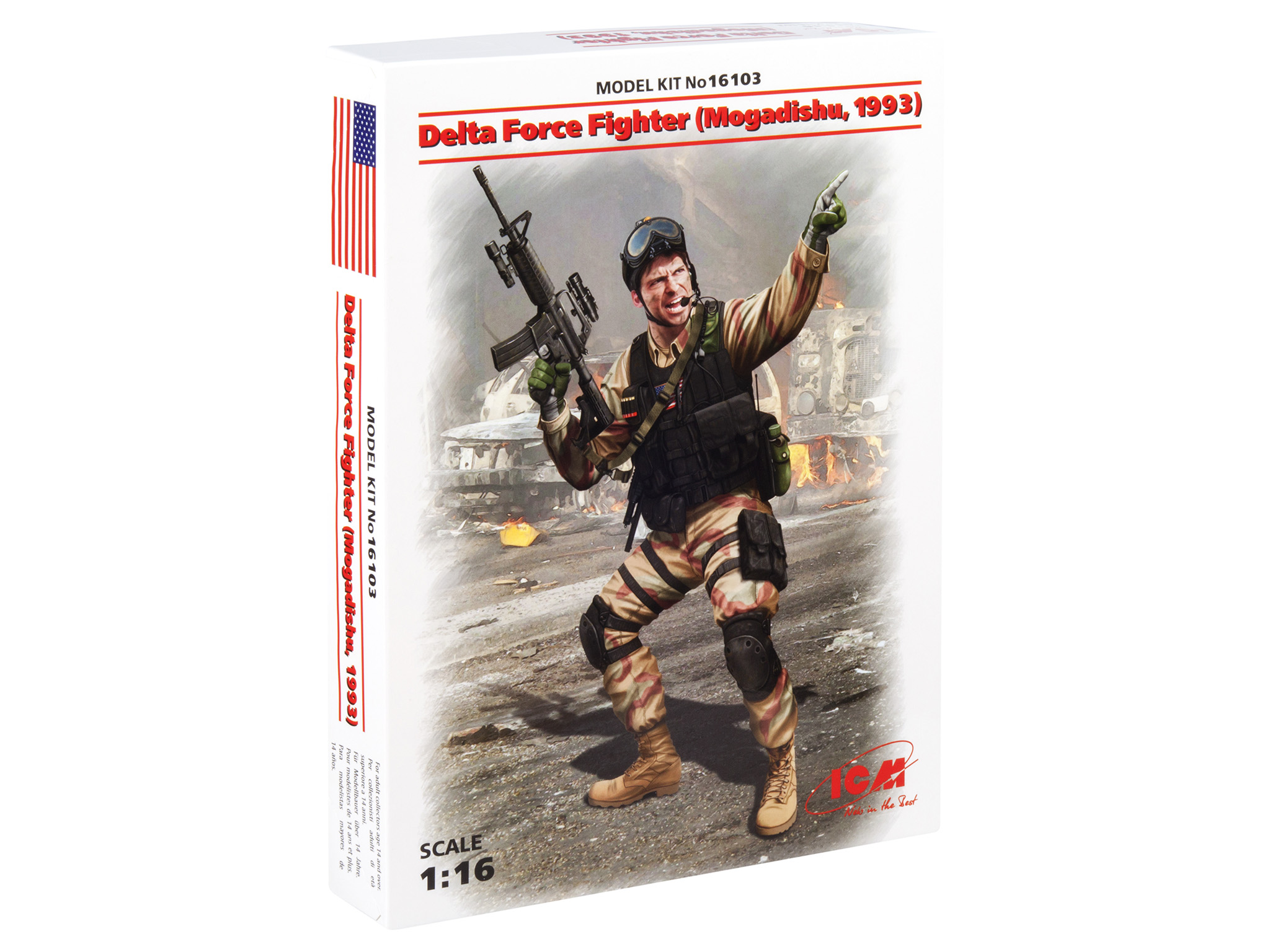
Product Description
Brand: ICM
Title: Delta Force Fighter (Mogadishu,1993)
Kit Number: ICM16103
Scale: 1:16
Parts: The set includes 25+15 parts for assembly a figure of Delta Force Fighter.
Additional Information: Requires Assembly – Paint and Glue sold separately
Delta Force Fighter (Mogadishu,1993)
“Delta Force,” officially known as 1st Special Forces Operational Detachment-Delta (1st SFOD-D), is one of the U.S. special missions units primarily focused on the counterterrorism mission. SFOD-Delta has been through a few name changes over the years, and even though it likely always will be known as SFOD-Delta, it recently was renamed the Combat Applications Group (CAG) and is now known officially as Army Compartmented Elements (ACE).
Though Delta Force is primarily a tier-one counterterrorism unit, specifically directed to kill or capture high-value units or dismantle terrorist cells, Delta Force remains extremely flexible and can engage in direct-action missions, hostage rescues and covert missions working directly with the CIA, as well as high-ranking protective services of our senior leaders during visits in war-torn countries.
Delta is under operational control of the Joint Special Operations Command (JSOC) though administratively supported by the Army Special Operations Command (USASOC).
The Battle of Mogadishu (Somali: Maalintii Rangers, ‘Day of the Rangers’), also known as the Black Hawk Down incident, was part of Operation Gothic Serpent. It was fought on 3–4 October 1993, in Mogadishu, Somalia, between forces of the United States—supported by UNOSOM II—and Somali militiamen loyal to Mohamed Farrah Aidid. The battle was part of the broader Somali Civil War. The United Nations had initially become involved to provide food aid to alleviate starvation, but eventually shifted their mission to establishing democracy and restoring a government.
On June 5, 1993, the U.N. would suffer the worst loss of its peacekeepers in decades when the Pakistani contingent was attacked while inspecting Aidid’s weapons storage sites. Aidid would be directly blamed for the incident and a hunt for him would begin that would characterize much of the U.N. intervention up until the Battle of Mogadishu. As part of the campaign to capture Aidid US forces in Mogadishu would launch the Abdi House raid, on July 12, 1993, resulting in the death of scores of elders and clansmen of Aidids clan, the Habr Gidr. This would lead Aidid and the SNA to deliberately target and kill American personnel for the first time on August 8, 1993, which would in turn lead President Clinton to dispatch the Task Force Ranger to capture Aidid.
On October 3, 1993, US forces planned to seize two of Aidids high-ranking lieutenants during a meeting deep in the city. The raid was only intended to last an hour, but morphed into an overnight standoff and rescue operation extending into the daylight hours of the next day. While the goal of the operation was achieved, it was a pyrrhic victory and spiraled into the deadly Battle of Mogadishu. As the operation was ongoing, Somali forces shot down two American Sikorsky UH-60 Black Hawk helicopters using RPG-7s. A desperate defense of the downed helicopters began and fighting lasted through the night to defend the survivors of the crashes. In the morning, a UNOSOM II armored convoy fought their way to the helicopters, incurring further casualties but eventually rescuing the survivors.
Casualties included 18 dead American soldiers and 73 wounded, with Malaysian forces suffering one death and seven wounded, and Pakistani forces suffering one death and two injuries. There were between 315 and 2,000 Somali casualties. The battle shifted American foreign policy and led to an eventual pullout of the U.N. mission in 1995.
In the aftermath of the battle, dead American soldiers were dragged through the streets by Somalis, which was shown on American television—to public outcry. Fear of a repeat of the battle was a reason for American reluctance to get further involved in Somalia and other regions. Some scholars argue that it was a major factor that affected the Clinton administration’s decision to not intervene in the Rwandan genocide, and has been commonly referred to as “Somalia Syndrome”


